You're doing everything right.
So why are you still exhausted?
The problem isn't your effort.
It's what you're carrying — and what you never put down.
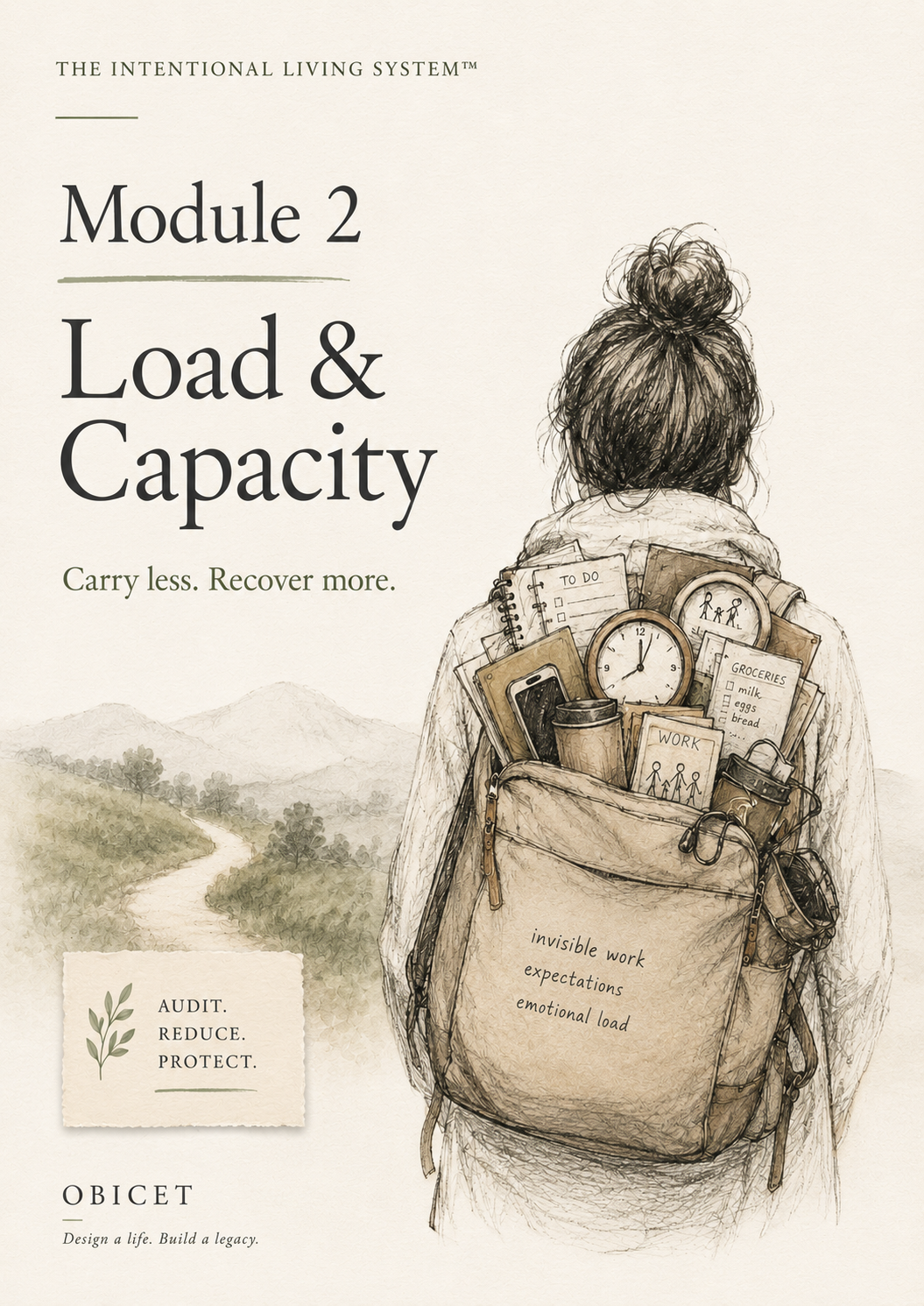
You are not behind because you are not trying hard enough. You are behind because the load was never counted.
Sound Familiar?
● Day done. Kitchen clean. Kids in bed.
Still feel behind.
●Sunday rest. But your mind is already on Monday.
The tank stays low.
●Six things tracked before 9am. None on any list.
None of them stop.
●Same wall every Thursday. Not a hard week. The load never changed.
It’s structural.
●Tried earlier mornings. Tighter schedules.
Works briefly. Then doesn’t.
WHAT’S ACTUALLY HAPPENING
The load was never
counted.
Most exhaustion isn't from the work you can see. It's from everything running quietly in the background.
The tracking no one acknowledges
Someone has to know what's low, what's coming, what was agreed. That someone is usually you. And it never stops.
The problems you solve before they happen
You're not reacting. You're constantly anticipating. That's invisible work — and it costs real energy.
The standard-keeping
When things slip, you notice. You decide. You adjust. No one sees the hundreds of small decisions that hold everything together.
The invisible labour
Reading the room. Smoothing friction. Keeping the peace. It doesn't appear on any list. It doesn't stop when you sit down.
The recovery that never lands
You go to bed tired. You wake up already behind. Real recovery isn't a reward — it's a requirement. And right now, it's not happening.
You're not behind because you're not trying hard enough. You're behind because the load was never counted.
Not all exhaustion is the same.
The Capacity
Ladder™
Most busy parents and working adults sit between Survival Mode and Managing. The goal isn’t to reach the top immediately. Move one rung — and have it hold.
Intentional Capacity
Generating. Directed. Growth is possible.
Sustainabiity
Load assessed. Recovery structural. Margin exists.
Managing [most people]
Stable but reactive. Holds on good weeks, struggles on hard ones.
Survival Mode
Functional outside. No margin inside.
Depletion
Empty. Small demands cause outsized reactions.
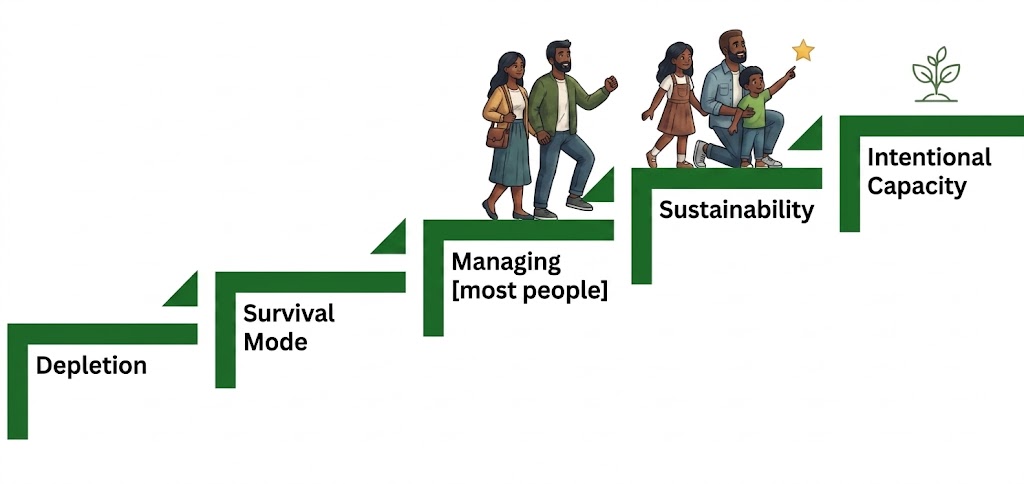
One rung, held consistently, is worth more than five rungs attempted and abandoned.
WHAT BECOMES POSSIBLE
A life that doesn’t
run you into the ground.
Mornings that don’t begin in a deficit.
Decisions made from capacity, not whatever’s left.
Evenings that feel like yours.
Sitting at the dinner table. Actually there.
A hard week that doesn’t collapse the whole system.
Ordinary days that don’t cost everything.
THE SYSTEM
Three phases.
One direction.
1 AUDIT
You cannot reduce what you haven’t counted. Five days of honest observation makes the invisible visible — the tracking, the hidden responsibilities, the recovery that never arrived.
2 REDUCE
Remove load that was never deliberately chosen. Release commitments that accumulated. Simplify standards that cost more than they return. Redistribute the invisible work.
3 PROTECT
Build recovery into the structure of every week — not as a reward, but as a requirement. A work boundary that holds. Energy aligned with when you’re actually capable.
Each phase feeds the next. The flywheel turns slowly — then holds itself.
Capacity changes everything — because it changes decisions.
HOW IT COMPOUNDS
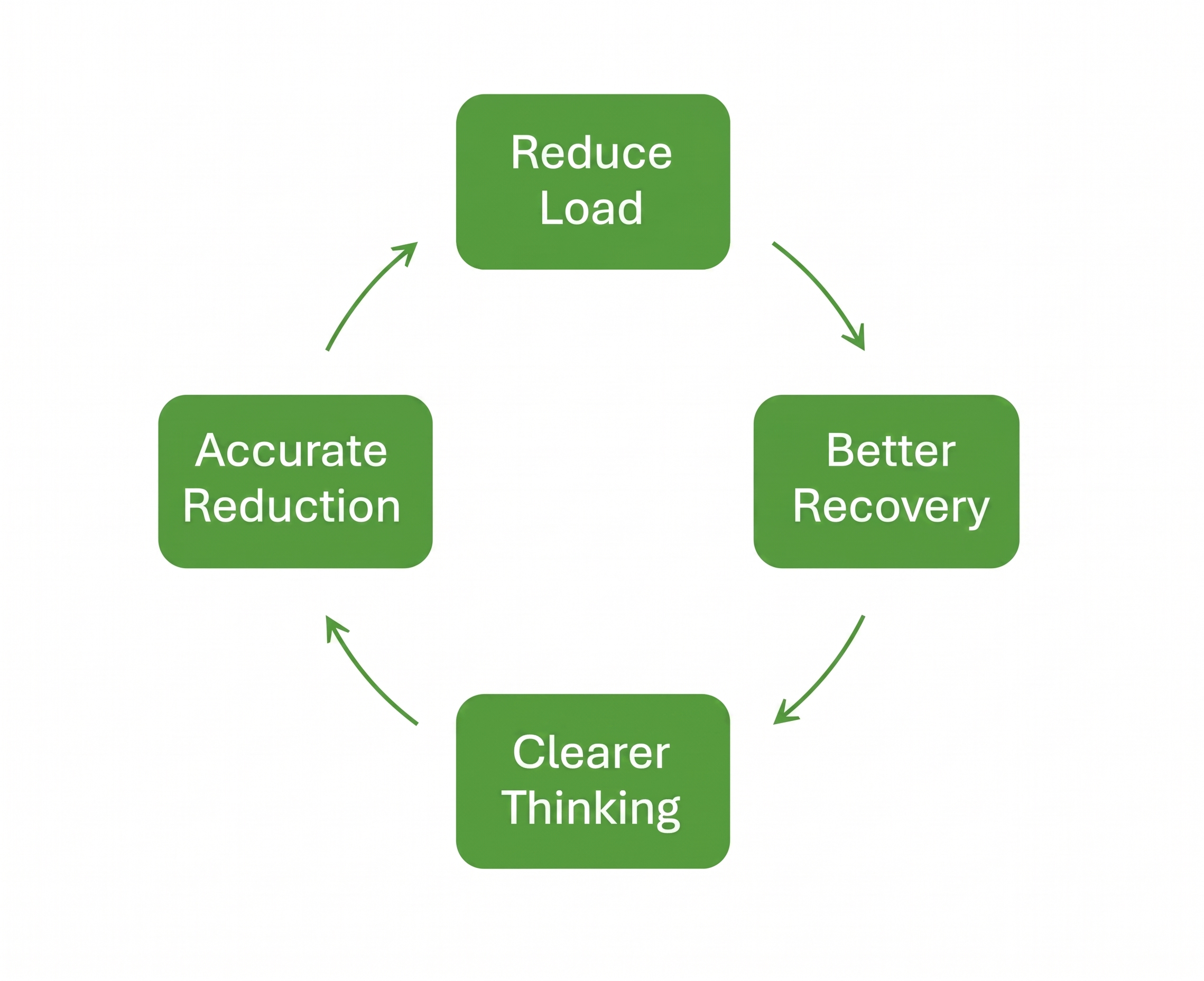
Reduced Load
less to carry
Better Recovery
genuine restoration
Accurate Reduction
Clearer Judgment
cut what matters most
better thinking
Reduced load → better recovery → clearer judgment → more accurate reduction → lighter load.
WHY OTHER SYSTEMS DON’T WORK
Built for output.
Not for your whole life.
Most systems address the visible layer — tasks, schedules, inbox zero. They’re useful. But they don’t touch what’s actually draining you.
TYPICAL PRODUCTIVITY SYSTEMS
Focus
Visible tasks and time
Hidden load
Not counted, not addressed
Recovery
A reward after the work
Built for
Individual output
Over time
Efficiency improves. Exhaustion continues.
THE INTENTIONAL LIVING SYSTEM
Focus
Total load — visible and invisible
Hidden load
Audited, named, redistributed
Recovery
A structural requirement, every week
Built for
Work, family, relationships
Over time
The baseline rises. Ordinary weeks stop costing everything.
GROUNDED IN RESEARCH
Not theory.
Evidence.

Background mental tracking reduces available focus, patience, and judgment — even when visible demands are light
Stress damage accumulates not from pressure, but from the absence of recovery between demands
The ability to mentally disengage from work is one of the strongest predictors of sustained performance
Based on research by Kahneman, McEwen, and Sonnentag.
This doesn't feel like motivation. It feels like relief.
From people like you
A quiet shift.
Then everything feels diffrent.
By week three I’d released two commitments and one piece of invisible work I’d carried for two years. Not dramatic — just real. Like putting down a bag I hadn’t noticed I was holding.”

John Maxwell
CEO, MaxTech Solutions
I kept thinking I needed more discipline. This module showed me the problem was never my effort — it was what I was carrying. The audit alone changed how I see every week.

John Maxwell
CEO, MaxTech Solutions
The Thursday wall. I’d had it for years. Eight weeks in, Thursday is unremarkable. I followed the sequence. That’s it.

John Maxwell
CEO, MaxTech Solutions
xxxxxxxxxxxxxxxxxxxxxxxxxxxxxxxxxxxxxxxxxxxxxxxxxxxxxxxxxxxxxxxxxxxxxxxxxxxxxxxxxxxxx

John Maxwell
CEO, MaxTech Solutions
The Guided Implementation Framework
Not more thinking.
A map out.
This isn't a reading exercise. It's a working document — designed for 10 minutes at a time.
You open it. You answer what's in front of you. By Day 5, you'll see your load clearly — probably for the first time.
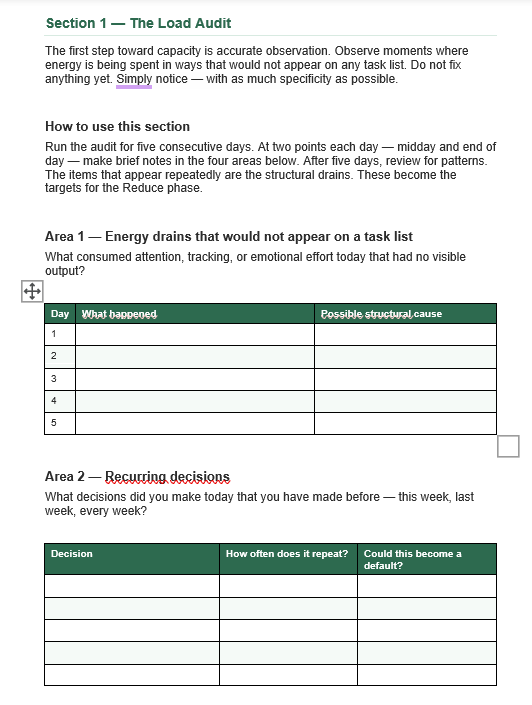

Inside the workbook
Use this space to add more details about your site, a customer quote, or to talk about important news. Share insights, showcase testimonials, or highlight new features to engage your visitors.
The 5-Day Load Audit
Identify the invisible tasks that are actually draining you — the ones that never appear on any list
Capacity Rung Mapping
Pinpoint exactly where you are and the one move needed to climb one rung — no more
Redistribution Scripts
Concrete language to share the invisible load with a partner, team, or family member — without guilt or conflict
Recovery Architecture
Design a weekly recovery structure that actually holds — protected, scheduled, non-negotiable
WHAT’S INCLUDED
The complete Module:
Load & Capacity system.
❖ The full guide — 21 chapters across philosophy, system, and implementation
❖ The complete workbook — 11 structured exercise sections
❖ The Load Audit — 5-day observation framework
❖ The Capacity Ladder™ — find your rung, find your next step
❖ The six-week rollout — sequenced, deliberate, sustainable
❖ The Weekly Capacity Check — 15 minutes to prevent drift
❖ Daily Recovery Design, Work Boundary & Energy Awareness frameworks
❖ The Invisible Work Redistribution guide
Delivered as PDF. Any device. No app, no subscription.
FAQ
No. Module 2 stands completely on its own. If you've done Module 1, this goes one layer deeper — from stabilising your environment to stabilising your capacity. But everything here makes full sense without it.
The Load Audit takes 10–15 minutes twice a day for five days. The Weekly Capacity Check takes 15–20 minutes. The daily recovery windows start at 20 minutes. This isn't another thing on your list — it's a system for shortening the list.
The module has an entire section on this — Section 11: When the System Slips. Every system slips under real pressure. The question isn't whether it slips. It's how quickly you return. The 24-hour reset process gets you back to baseline without starting over.
Yes. The invisible load — mental tracking, unresolved decisions, standards maintenance, the work boundary that doesn't hold — exists in every life. The redistribution sections adapt to whatever shared life you have, whether that's a partner, a team, or nobody. The Load Audit, the Capacity Ladder, and the recovery framework are entirely individual.
That's exactly why the sequence starts with observation, not action. The first two weeks ask you to notice — not fix. And the module is designed around one principle: if it starts feeling like pressure, you're moving too fast. One rung. One reduction. One protected window. That's enough to begin.
Start simple.
Follow the sequence.
You were carrying more than was ever counted.
That changes now.
Not because you'll try harder. Because for the first time, you'll see the full picture — and know exactly what to do with it.
One module. Ten minutes at a time. Real recovery. Lighter weeks. A home that actually holds.
Part of The Intentional Living System™ by Obicet. No prior modules required. Yours on any device, immediately.


© 2026 Obicet. All rights reserved.